
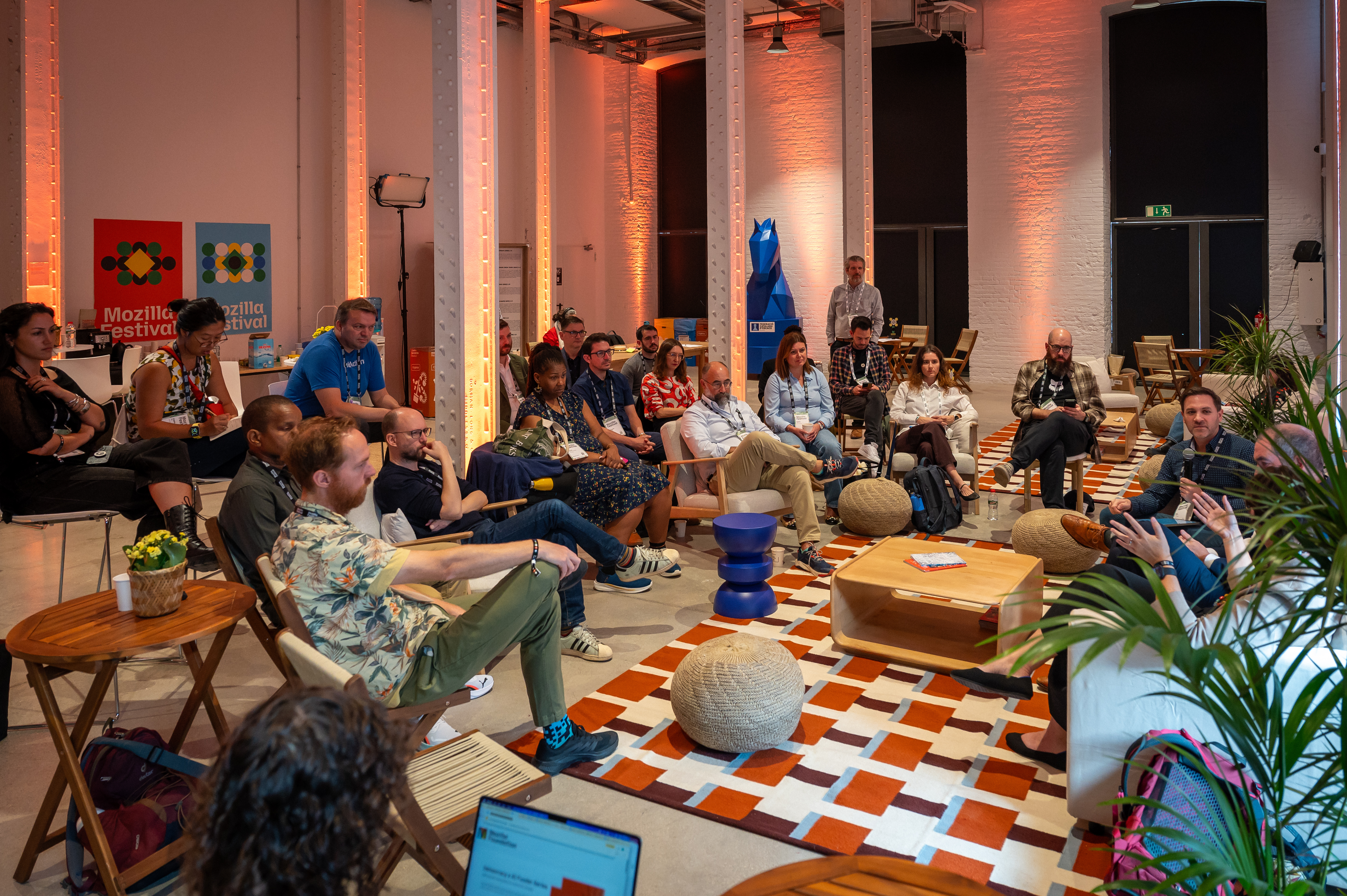
On Thursday at MozFest in Barcelona, I spent a full day on one question: what does it take for a credential earned in one place to count somewhere else? It started with a working breakfast I hosted with DataKind before the festival opened, continued with an afternoon panel DataKind ran on the main stage, and ended on a terrace with the Digital Public Goods Alliance (DPGA). Three rooms, roughly the same problem, approached from three directions. What follows are the themes I came away with, in the order the day unfolded.
The breakfast: from classrooms to crisis zones
Before 9am, about twenty-five people from UNICEF, foundations, civic tech shops, open source projects, and AI-for-good communities crowded into the Funder Lounge for a session we called "From Classrooms to Crisis Zones." DataKind convened it, with DARO and TechChange as co-hosts, and I had the job of emcee. The format was simple: a fireside conversation with Mac Glovinsky, who leads UNICEF's Learning Passport, and Caitlin Augustin, VP of Product and Programs at DataKind, followed by twenty minutes of small-table work and report-backs.
The session ran under Chatham House rules, so what follows are themes, not quotes.

Why this, why here
Sixteen years ago, Mozilla introduced Open Badges at MozFest. The idea was that learning which happens anywhere, at any time, should be recognizable. It felt right to ask, in the same city, how far we have come.
The honest answer seems to be that the technology has come a long way and the problem has gotten worse. More young people are on the move than at any point in recent memory, pushed by conflict, climate, and economic crisis. A learner can finish a year of school in one country, cross a border, and find that none of it counts. A college student who transfers can lose most of the credits they already earned. A community health worker who has delivered care for a decade can still be classified as a volunteer with no path into the formal health system. These look like different problems. The bet behind the breakfast was that they are the same problem, and that the humanitarian and education communities have been trying to solve it from opposite ends without talking to each other much.
Learning Passport is the proof that the bridge is not theoretical. It is UNICEF's flagship digital learning and skilling program, built with Microsoft, now running in more than fifty countries and reaching millions of learners, many of them displaced. A system built for crisis contexts is already solving the problem that education philanthropy is trying to solve from the other direction.
DataKind, for its part, works across US higher education, humanitarian response, and economic mobility to strengthen the data foundations that help organizations make better decisions and deliver greater impact. In higher education, that includes the Global Unified Initiative for Data in Education (GUIDE), a collaborative effort led by DataKind in partnership with TechChange to develop and support an adoptable, open-source public-good data model for student success. DataKind is also exploring emerging approaches to workforce credentialing, starting with community health workers, to strengthen recognition of skills and support career pathways.

Three things I heard in the fireside
- The paths people actually take are not linear, and our systems still pretend they are. School, then training, then one career, then retirement was probably never true for most of the world. It is certainly not true now. Any credentialing infrastructure that assumes a tidy sequence will fail the people who need it most.
- This is not mainly a technology problem. There are standards for interoperable credentials today. What is missing is acceptance. A credential is a two-sided thing: it only works if someone on the other side agrees it counts. That makes it a trust and governance challenge first, and a data standard second.
- Who decides what counts has quietly changed. For a few hundred years the state certified learning. Now that role is shared, and increasingly contested, by universities, employers, platforms, and the companies building the AI systems the next economy will run on. That is unsettling, but it also means civil society has a real voice in the outcome, and the window to use it is short.

What the tables surfaced
I asked each table to name one kind of learning that goes unrecognized, one certifier who would need to accept it, and one barrier. The report-backs were richer than that. A few threads stood out:
- Planned versus unplanned movement. Climate migration can, in principle, be planned for. Conflict often cannot. Several people asked whether there could be a ready-made template for recognizing prior learning that gets switched on when a crisis hits, instead of being rebuilt every time.
- Work experience versus paper. Multiple tables observed that work experience is often a better predictor of success than a degree, yet job postings still require the degree. The trades have unions that certify skill levels. Software and most of the knowledge economy have no equivalent.
- The cost of starting over. Stories about doctors and other professionals forced to repeat five-year programs after moving countries, with real costs in time, money, and patients unseen in the meantime.
- Whose stamp do you trust? One table asked whether an employer would trust a credential issued by another company more than one issued by a government. Nobody had a clean answer, but there was broad interest in using certifiers that already exist rather than inventing a new layer on top.
- Funding innovation, not scale. We are good at funding pilots in this space and bad at funding the governance and maintenance that let anything grow. Governance is not sexy. It is also the thing that is missing.
- Certification is not mobility. Credentials only matter if there are jobs and pathways on the other side. Otherwise we are producing well-documented people with nowhere to go.
- Mental health is part of the picture. A learner who can see a future for themselves prepares differently than one who cannot. Recognition of prior learning is part of what makes a future visible.
The closing synthesis from the room landed on urgency, opportunity, and responsibility, and on resisting the urge to design the perfect central system. The social sector loves to pick a winner: one authority, one standard, one platform. This conversation made clear that there will always be many authorities with different incentives. The opportunity is not to replace them. It is to build interoperability between them, which fits the festival's "rewilding" theme well.
The afternoon panel went deeper
At 3:30pm I was in the audience for "Rewilding Opportunity: Building Digital Infrastructure Around People," moderated by Caitlin Augustin with Mac Glovinsky; Erik Arnold, Vice President of Sector Initiatives at DARO; Larry Kilroy, VP of Technology at DataKind; and Kerri Lemoie, Executive Director of the Digital Credentials Commons. Where the breakfast was about naming the problem and hearing from the room, the panel moved toward what a solution would have to look like.

Four ideas carried over and sharpened:
- Fragmentation was a design choice. The systems that hold learning records were built to lock data in, and in many cases the institutions that generated the data no longer know whether they own it or can export it. That was not an accident, and undoing it is not primarily an engineering task.
- The learner should own the credential. Most of today's infrastructure treats the issuing institution as the owner, with the learner as a subject of the record. Flipping that, so the person carries and controls their own verifiable record and can take it when a platform dies or a border is crossed, is both a privacy argument and a portability argument.
- Interoperability was described as a right, not a nice-to-have. Build to a spec, then customize at the edges. The panel kept returning to a foundation-and-house image: agree on an open, safe foundation (the open standards for verifiable credentials already exist) and let every country and institution build what it needs on top. Most of the cost and most of the interoperability damage happens in the last mile of customization, so a shared foundation buys everyone time and money to get that part right.
- Standards die when adoption costs money and the value is not obvious. The panel was blunt that most standards fail because someone else is expected to spend time and budget adopting them without a clear return. Incentives have to work for issuers, verifiers, and learners at the same time, or the credential becomes one more innovation that never leaves the pilot. The technology is old and cheap to implement; the lock-in incentive is what holds companies back.

The side event: digital public goods on the terrace
The day ended at a happy hour the Digital Public Goods Alliance hosted with DataKind. The DPGA had launched its DPG for AI collection at the festival that week, and the room was full of people who build and steward open tools that anyone can take and use, such as Wikidata, Open Referral, Bloom Housing, and more.
The DPGA host asked each of us to name the question or topic we wanted to explore. The answers were a decent map of what this community is worried about:
- Sustainability models for digital public goods
- Governance layers for digital public infrastructure (DPI)
- How to assemble a coherent stack of DPGs rather than a long list of them
- How companies create and capture value by contributing
- How to get more funding into the whole ecosystem
My focus was community layers around DPI and DPG projects. That's relevant to the work TechChange is doing with DataKind on GUIDE. The model is intended to provide a shared data foundation for greater interoperability, student success, and responsible AI. It also needs a community of people to understand it, adopt it, and help improve it... or it stays a document.
Digital public goods are the natural foundation layer the panel described, open and owned by no one. The registry is where they get discovered and vetted. What the registry cannot supply is the community around each one, and that is where most of them stall.

What I am taking away
For TechChange, this is close to home. We spend our time building learning programs and running convenings where recognition of what people learned matters, and increasingly our clients ask how AI changes that. If the answer is that AI accelerates the question of trust rather than resolving it, then the next two years are the time to get the governance right. We will be carrying this into the Global Digital Health Forum in Bangkok this December, where the health workforce version of this problem will be very much on the agenda.
What happens next
DataKind is following up with the people who were in the room, and the invitation is open to anyone working on this. There are a few ways in:
- Share your perspective: Bring your experience and ideas to help shape what comes next.
- Explore and experiment: Identify opportunities to test approaches, contribute a system or use case, and learn together.
- Connect and collaborate: Join a working group or help convene and support the next stage of the work.
If you work on credentialing in education, humanitarian response, or workforce development and want in, contact DataKind at partners@datakind.org. If your interest is the higher education side of this, GUIDE is the place to start: guide.datakind.org.